November 4, 2026      Applications      By 3DPTimes Editors | Research analysis | Source: Zhang et al., PLOS One, October 28, 2026.      6

An October 28 PLOS One study reports rapid AI-generated scaffold geometry and promising computational benchmarks. 3DPTimes examines the design advance, its limited dataset and the manufacturing evidence still needed.

Scaffold geometries generated for different design targets, with normalized simulated stress overlays. Computational visualization, not printed specimens. Image: Zhang et al., PLOS One (2026), Fig. 5, CC BY 4.0; resized. https://doi.org/10.1371/journal.pone.0361041.g005
A faster way to explore candidate architectures

Researchers at Beijing Rehabilitation Hospital, Capital Medical University, have introduced ScaffoldForge, a conditional diffusion model for bone-scaffold design. The study by Yaohua Zhang, Hongyue Zhang and Huaqing Yang was published in PLOS One on October 28, 2026.

The authors report generating a scaffold geometry in about 12 seconds on an NVIDIA A100 GPU, compared with approximately 8,400 seconds for their topology-optimization baseline. That is a roughly 700-fold reduction in the compared design-stage runtime. All reported results are computational: the team did not fabricate or experimentally test the generated scaffolds.

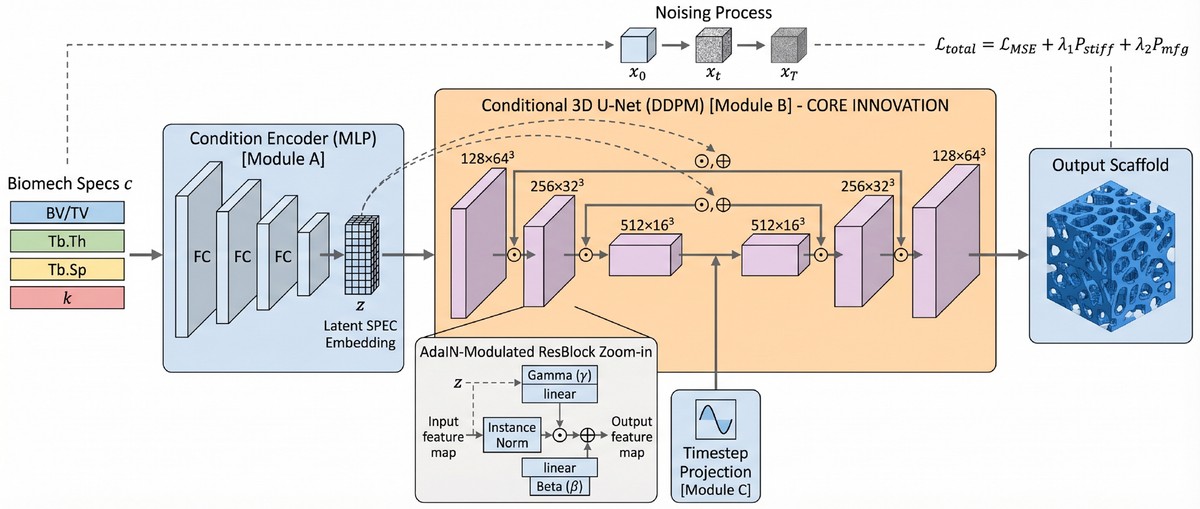
The model accepts eight descriptors covering bone-like architecture and fluid transport, then refines noise into a 64 × 64 × 64 voxel geometry through a denoising process. For designers, the potential benefit is a shorter cycle for exploring candidate structures against specified targets.

The conditional-generation framework links target descriptors to a scaffold geometry. Research diagram: Zhang et al., PLOS One (2026), Fig. 1, CC BY 4.0; resized. https://doi.org/10.1371/journal.pone.0361041.g001

What the mechanical and manufacturing claims mean

The study reports estimated compressive strength of 56.6 MPa, 8.2% above the topology-optimization comparison. That figure describes computational evaluation, rather than a load measured on a newly printed implant. Topology optimization retained slightly higher permeability in the comparison, illustrating the trade-off between structural performance and an open pore network.

During training, empirical penalties address insufficient predicted stiffness, manufacturing overhangs and inadequate permeability. The authors explicitly distinguish these soft constraints from first-principles physical laws. Their comparison images show how these terms change connectivity and reduce isolated material in the generated geometry.

For additive manufacturing, this is a useful design filter. Process-specific checks would still need to examine minimum feature size, support removal, dimensional changes and whether the selected material and process can reproduce the intended pore network.

The paper compares generated geometries without and with its physics-related loss terms. This is a computational comparison, not a print test. Image: Zhang et al., PLOS One (2026), Fig. 2, CC BY 4.0; resized. https://doi.org/10.1371/journal.pone.0361041.g002

An anatomical fit demonstration with a data limitation

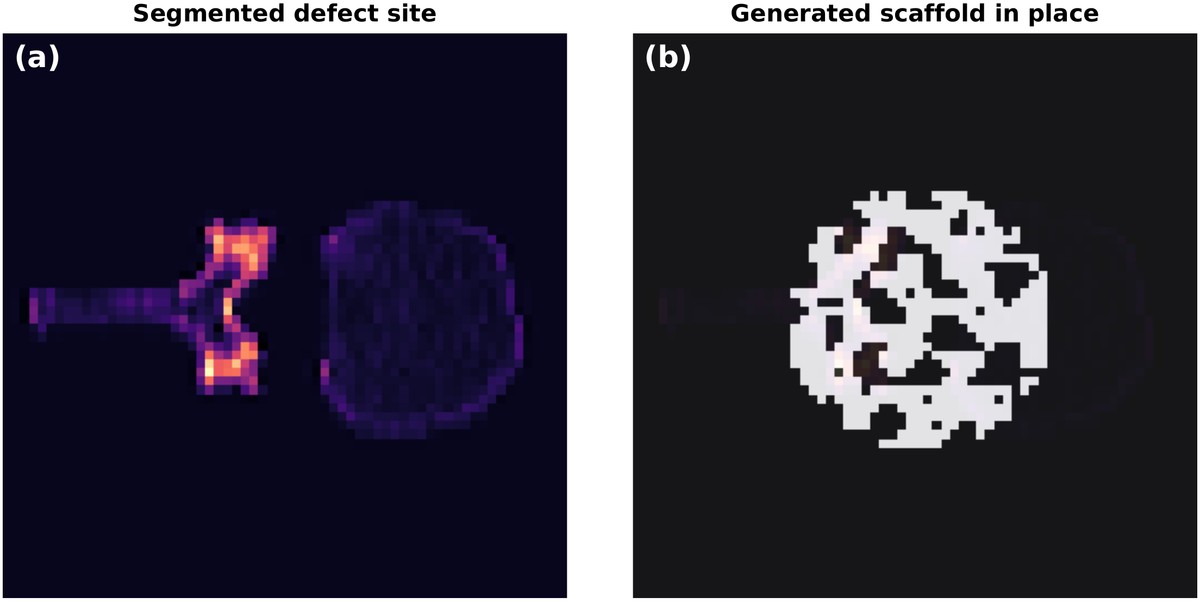
The team also presents a CT-to-scaffold workflow: identify a defect, generate a candidate architecture and trim the geometry to the defect boundary. The reported evaluation uses 20 cases from a public spine-imaging benchmark. It demonstrates a route toward anatomically matched design; it does not establish surgical suitability or biological integration.

The initial corpus contains 200 procedurally generated architectures and 50 real reference scaffolds. Expanding the corpus to 2,050 geometries, while retaining the same 50 real references, reduced descriptor error on unseen anatomy from 0.079 to 0.058. This improvement addresses computational generalization without adding new experimental validation of generated parts.

For 3DPTimes, the important question is how performance transfers to anatomy, loading conditions and fabrication processes outside the development data. A good match to requested descriptors provides one part of that evidence.

A segmented defect and a generated scaffold fitted to its boundary in the study’s imaging workflow. This is a computational illustration, not evidence of implantation. Image: Zhang et al., PLOS One (2026), Fig. 6, CC BY 4.0; resized. https://doi.org/10.1371/journal.pone.0361041.g006

The next milestone is a printed and measured scaffold

ScaffoldForge’s immediate contribution is to computational design research. Faster candidate generation could let engineers examine more alternatives before committing to fabrication. The decisive next comparison is between predicted behavior and measurements on manufactured specimens.

That work would include assessing geometry after printing, mechanical response, fluid transport and the effects of subsequent processing. Biological performance and regulatory evaluation remain additional stages. The reported 12-second runtime applies to generating a candidate geometry; it does not measure the time required to make, validate or approve an implant.

The authors identify physical testing as future work. Until those results exist, the strongest supported conclusion is that the method accelerates an in-silico design workflow.

Primary source
Zhang Y, Zhang H, Yang H. “ScaffoldForge: Bioinspired generative design of 3D-printed bone scaffolds via conditional diffusion for large segmental bone defect reconstruction.” PLOS One 21(10): e0361041. Published October 28, 2026.
https://doi.org/10.1371/journal.pone.0361041

Image license and attribution
Figures 1, 2, 5 and 6: © 2026 Zhang et al., PLOS One, reproduced under the Creative Commons Attribution 4.0 license. Images were resized and converted to JPEG for web delivery; their scientific content was not edited.
https://creativecommons.org/licenses/by/4.0/

Original reporting and editorial analysis: 3DPTimes. Primary source reviewed November 3, 2026.


©2026 3dptimes.com All Rights Reserved