
Home  >  Materials

October 15, 2025      Materials      193

University of Colorado Boulder releases OpenVCAD, an open-source software enabling precise multi-material 3D printing through code-based design.

Graded lattice with soft/hard regions

Researchers from the Department of Computer Science at the University of Colorado Boulder (CU Boulder) have released a new open-source design tool for multi-material 3D printing – OpenVCAD. This new software enables precise control over the distribution of different materials within a 3D object through functions and code, allowing engineers to perform efficient printing using multiple materials.
Traditional Computer-Aided Design (CAD) software has long primarily used boundary representation modeling, assuming objects are made of a single, homogeneous material internally. This makes it difficult to support the complex design requirements of multi-material and gradient materials. OpenVCAD flexibly defines the spatial distribution of different materials inside a 3D object through functions and code, achieving an efficient transition from coarse, stair-stepped material distributions to smooth gradients. It provides a powerful design infrastructure for multi-material 3D printing.

The OpenVCAD project was completed by the "Laboratory for the Computational Assembly of Matter" led by Robert MacCurdy, Assistant Professor in the Paul M. Rady Department of Mechanical Engineering. Professor MacCurdy explained: "Multi-material design has always been a challenge in engineering. The emergence of OpenVCAD provides engineers with a unified and efficient platform for multi-material design, significantly lowering the barrier to development."

The related research has been published in the Additive Manufacturing journal, titled "Implicit toolpath generation for functionally graded additive manufacturing via gradient-aware slicing"
Breaking Through the Limitations of Traditional CAD Software

One area of significant interest in mechanics is so-called graded design, which involves gradually blending two materials, much like a shoe sole transitioning from hard to soft. However, without powerful design tools, converting coarse, stepped designs into smooth transitions is exceptionally difficult. It was for this reason that Charles Wade, a Ph.D. student in the Department of Computer Science, participated in developing OpenVCAD. This software package acts almost like a convenient toolkit, not only allowing users to easily write complex functions but also to assign them as materials to objects in a 3D printer.

Wade stated: "This is the first widely available, code-based design tool for multi-material objects. It adapts well to the complexity of printed objects, is easy to start with, and the writing and design process is intuitive. Unlike traditional CAD software, where every change requires re-sketching and it's impossible to represent graded materials, our tool allows users to simply change a single variable and easily see the entire design update."

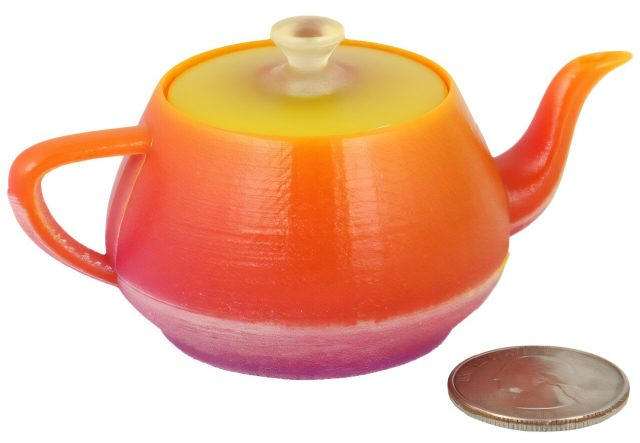
A multi-material teapot model printed using OpenVCAD, demonstrating exceptional detail control capability

Suitable for Various 3D Printing Scenarios

The research team has already validated OpenVCAD's functionality on various 3D printers, including one used by MacCurdy's lab team that allows printing objects with up to five materials at once. However, what truly excites them is the project's potential impact on the entire engineering community.

MacCurdy's team points out that OpenVCAD's applicable fields are extremely broad, potentially helping researchers from almost all industries design needed objects. For example:

Surgeons could benefit from the gradient blending function to create realistic anatomical models for pre-operative planning.

Soft robotics experts could use it to design flexible actuators that bend in specific directions while remaining rigid in others.

Engineers could directly complete the design of complex multi-material objects within the software and easily export files for subsequent simulation analysis.

Scanning a printed medical model. Researchers enable engineers to design such multi-material 3D printed objects more efficiently through OpenVCAD software.
OpenVCAD can even apply specific mechanical properties to particular sections of lattice structures, which are often used to absorb impact forces, enabling more complex designs. MacCurdy said: "We can rely on OpenVCAD's core functionality to represent multi-material objects across many different fields. But we anticipate even more capabilities in certain areas in the future. We genuinely hope this multi-material design approach will be successful."

OpenVCAD is released as fully open-source and is compatible with Python, allowing global users to import it easily and get started quickly. The team hopes that through open sharing, it will promote technological advancement and community collaboration in the field of multi-material additive manufacturing. Wade added: "We look forward to OpenVCAD being adopted more widely, helping engineers and researchers globally achieve best design practices."


©2025 3dptimes.com All Rights Reserved