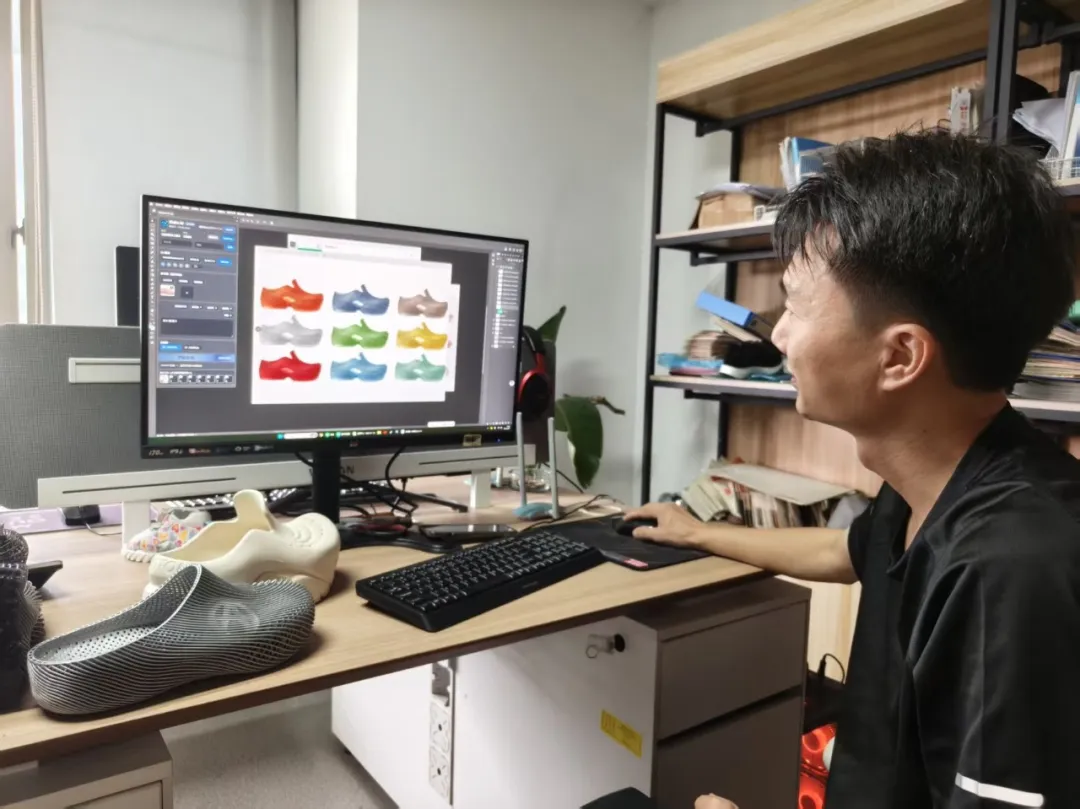
No assembly lines, no crowds of workers – just three steps to go from design to finished shoe.
In the lab of the Wenzhou Shoe Capital Designer Collaborative Innovation Center, futuristic 3D‑printed shoes slowly “rise” from a pool of liquid polymer, oozing with high‑tech appeal.
The traditional shoemaking process, which once involved over a hundred steps, has been completely upended. Leveraging AI design and 3D printing, small tech teams in Wenzhou are now handling production volumes that used to require factories with thousands of workers – all in a lean, lightweight model. Right now, orders for many Wenzhou‑based 3D‑printed shoe manufacturers are already backed up for two months.
At the heart of this shift is a full‑scale digital upgrade. Take Juxie Youpin, for example – the team developed its own AI footwear design system that uses intelligent modeling to optimize shoe structure and ergonomics. The system has been recognized as a benchmark case for AI‑driven manufacturing in Zhejiang Province, China. What’s more, they’ve brought core printing equipment and software development in‑house, achieving full self‑sufficiency.
Materials used to be the biggest bottleneck. High‑end shoemaking materials were largely imported, expensive, and prone to hydrolysis. But Zhejiang Huafeng New Materials teamed up with Juxie Youpin to develop a custom polymer compound specifically for 3D‑printed shoes. It withstands over 100,000 flex cycles without cracking, and offers far better value than anything from overseas.
The design phase has also undergone a radical transformation. Traditional custom shoemaking required at least two weeks of modeling, and even a minor tweak meant starting over. Now, with AI‑powered tools, a complete custom design can be turned around in just one to three days – perfectly matching the industry’s growing need for small batches, fast iteration, and high flexibility.
Perhaps even more striking is the collaborative ecosystem. The innovation center brings together a cluster of tech startups, with upstream and downstream partners literally working floors apart. Easy communication, shared resources, and tight technical coordination turn these once‑isolated small firms into a cohesive force.
The technology has already been licensed to several leading shoe companies in Wenzhou, and 3D‑printed models are increasingly showing up on retail shelves. Priced at around 800 to 1,000 yuan (approximately $110–$140 at current exchange rates), they’ve become a hit with younger, fashion‑conscious consumers. Some firms are now testing overseas markets, exploring export channels for their tech‑driven products.
According to the Wenzhou Leather and Footwear Industry Association, the 3D‑printed footwear sector is still in its infancy both in China and globally. Yet Wenzhou, through its independent innovation, has already blazed a viable commercial path – offering a high‑value local model for the traditional industry’s transformation.