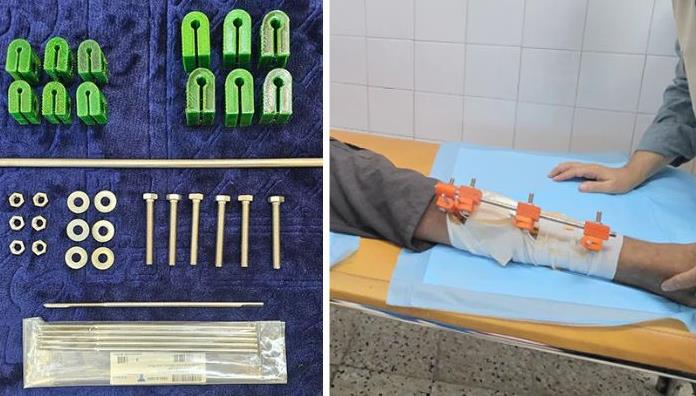
Gaza doctors create world’s first 3D-printed external fixator using local materials, saving patients from amputation amid supply shortages.
In one of the world’s most severely affected healthcare systems, a team of doctors and engineers has achieved an unprecedented breakthrough. GLIA, an international medical aid organization, has designed and produced in Gaza the world’s first 3D-printed external fixator—an essential orthopedic device used to treat complex fractures. The project was successfully carried out using locally available materials, 3D printing, recycled plastic, and solar power, in a context where supplies are extremely limited and conventional medical equipment is largely inaccessible.
This device has already prevented amputation or permanent disability in three patients. This advancement comes at a time when over 90% of healthcare facilities are damaged or destroyed, the entry of medical supplies is severely restricted, and hospitals face an acute shortage of equipment needed to provide basic trauma care.
How an External Fixator Works and Why It Is Essential in Gaza
Known as the “x-fix,” this external fixator is used to align fractured bones and is particularly valuable because it can be adjusted according to the specific type of fracture. Under normal conditions, surgeons choose an external fixator when a fracture is too unstable for internal fixation or when surrounding tissue is too damaged for immediate surgery. This makes it a critical tool in emergency situations, especially because it allows surgeons to effectively “pause” a patient’s condition: it stabilizes and protects the injury, giving the patient’s body time to fight infection or recover from traumatic shock.
However, its effectiveness depends on how quickly it is applied. Dr. Tarek Loubani, Medical Director of GLIA, notes that delaying the placement of an external fixator can lead to amputation or, in the worst cases, death. Conventional external fixators can cost over $500, require specialized imports, and have become largely unavailable due to the Israeli blockade. In the Palestinian context, where hospitals operate on the brink of collapse and commercial devices cannot easily enter the Gaza Strip, the ability to produce medical tools and equipment locally has become a vital necessity.
A Device Made from Locally Sourced Materials
Despite constraints imposed by the geopolitical situation, the doctors had one advantage: most materials needed to manufacture the X-fix could be found locally. “For several weeks, we knew that within the rubble lay the type of metal we needed to make the external fixator components,” explains Dr. Tarek, describing how metal rods are then connected to plastic joints produced via 3D printing. All plastic components are made from recycled materials.
Production is slow—printing a single component can take up to 12 hours—but the process is now fully operational. Twelve more patients are waiting for the fixator. To date, these 3D-printed devices are the only means of providing precision, reproducibility, and safe support to patients who need it most. The goal is to eventually transition to a faster plastic extrusion system. However, uncertainty around the ceasefire and the risk of renewed attacks make long-term planning extremely difficult. One of GLIA’s facilities in Gaza, for example, has already been targeted in the past, fortunately without casualties.
The good news is that the device is fully open source. Jen Wilson, Director of Production and Design at GLIA, explains that the organization does not intend to patent any part of the X-fix or profit from these devices. The goal is for it to be replicated wherever it is needed, especially in low-income or conflict-affected areas.