Scientists from the Indian Institute of Tropical Meteorology (IITM), Pune have begun developing 3D printed Automatic Weather Stations (AWS) to increase the number of weather observation points across the country.
Backed by the Ministry of Earth Sciences (MoES), the work is being carried out under Mission Mausam (Season), a ₹2,000 crore (approx. $222.3 million) government programme focused on upgrading India’s weather observation and forecasting systems.
Scientists have pointed out that existing network density remains insufficient for highly localised forecasting, particularly in urban areas and in complex terrain such as the Himalayan region. The new stations are intended to expand coverage of basic parameters such as temperature, wind, humidity, and rainfall.
Before being used independently, the AWS units will be tested, calibrated, and validated alongside existing manual observation stations. Initial installations are planned in Delhi starting next month, and the devices will operate on solar power.
“Our objective is to expand the observational network so comprehensively that data gaps are eliminated,” Dr. M Ravichandran, Secretary of MoES, told News18. Capturing the parameters at extra locations, “will allow much more accurate local-level forecasts.”
Addressing gaps in India’s weather network
At present, the India Meteorological Department (IMD) operates over 1,000 AWS, 547 manual surface observatories, and 1,382 Automatic Rain Gauges across India. Earlier this year, some stations operated by the IMD produced unusually high temperature readings. Investigations later found that the errors were caused by damaged sensors or unsuitable installation sites.
Because of this, the newly 3D printed stations will not be put into standalone use immediately. They will first be set up next to existing manual observatories and will go through a process of testing, calibration and validation before their data is relied upon.
The choice of 3D printing is linked to cost and design considerations, since it allows components with complex shapes to be produced more easily and at lower expense. All meteorological instruments developed in this way will be certified by the IMD’s Surface Laboratory, which is recognised by the Bureau of Indian Standards (BIS).
According to the IITM, 50 units have already been manufactured. If their performance is satisfactory, they will be deployed in major cities in the initial phase, and another 80 units will be produced and installed over the following six months.
Additive manufacturing for weather observation
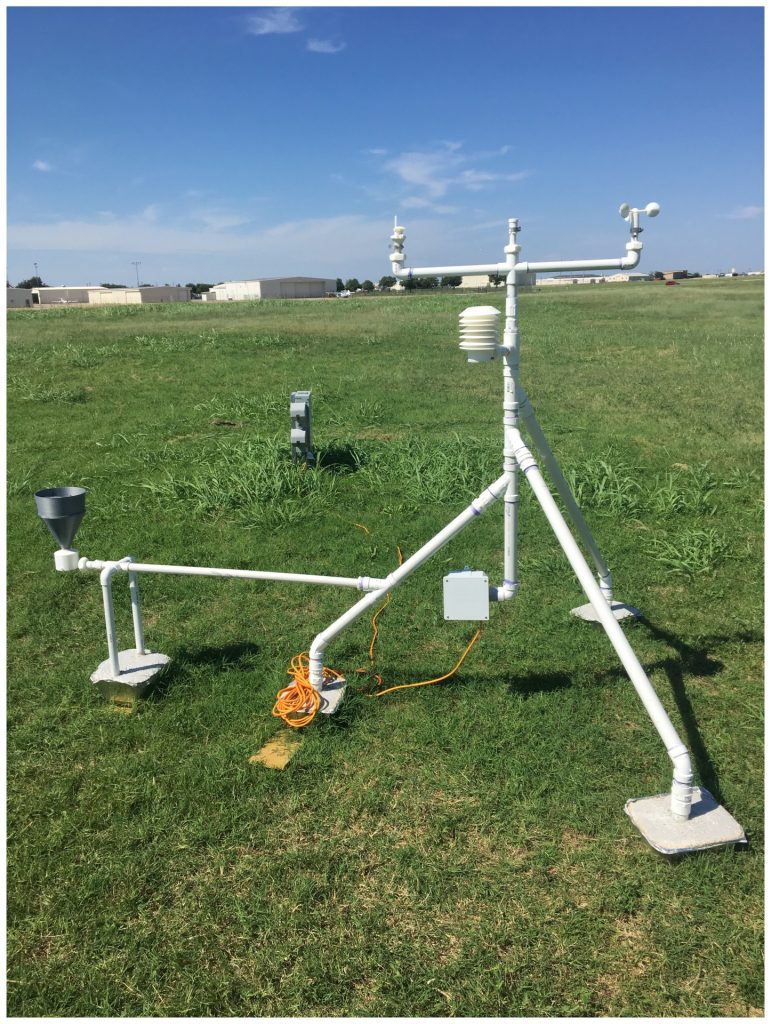
3D printing has been used for environmental monitoring devices before. For instance, a team from the University of Oklahoma and Argonne National Laboratory developed a low cost 3D printed weather station based on open source designs from the 3D PAWS initiative, using over 100 3D printed parts. The system was tested in Oklahoma for eight months against a commercial station and delivered largely comparable measurements.
Built using ASA plastic and low cost sensors, it operated for five months before humidity sensor corrosion and component degradation appeared. Most instruments performed reliably, though the 3D printed anemometer showed reduced accuracy due to print quality limitations.
In August 2020, researchers at Oak Ridge National Laboratory (ORNL) developed a 3D printed smart wall known as EMPOWER that incorporated weather monitoring functions. Designed for indoor use as a demonstration of additive manufacturing, the structure combined 3D printed concrete with embedded electronics and was intended to function as a room’s cooling system.