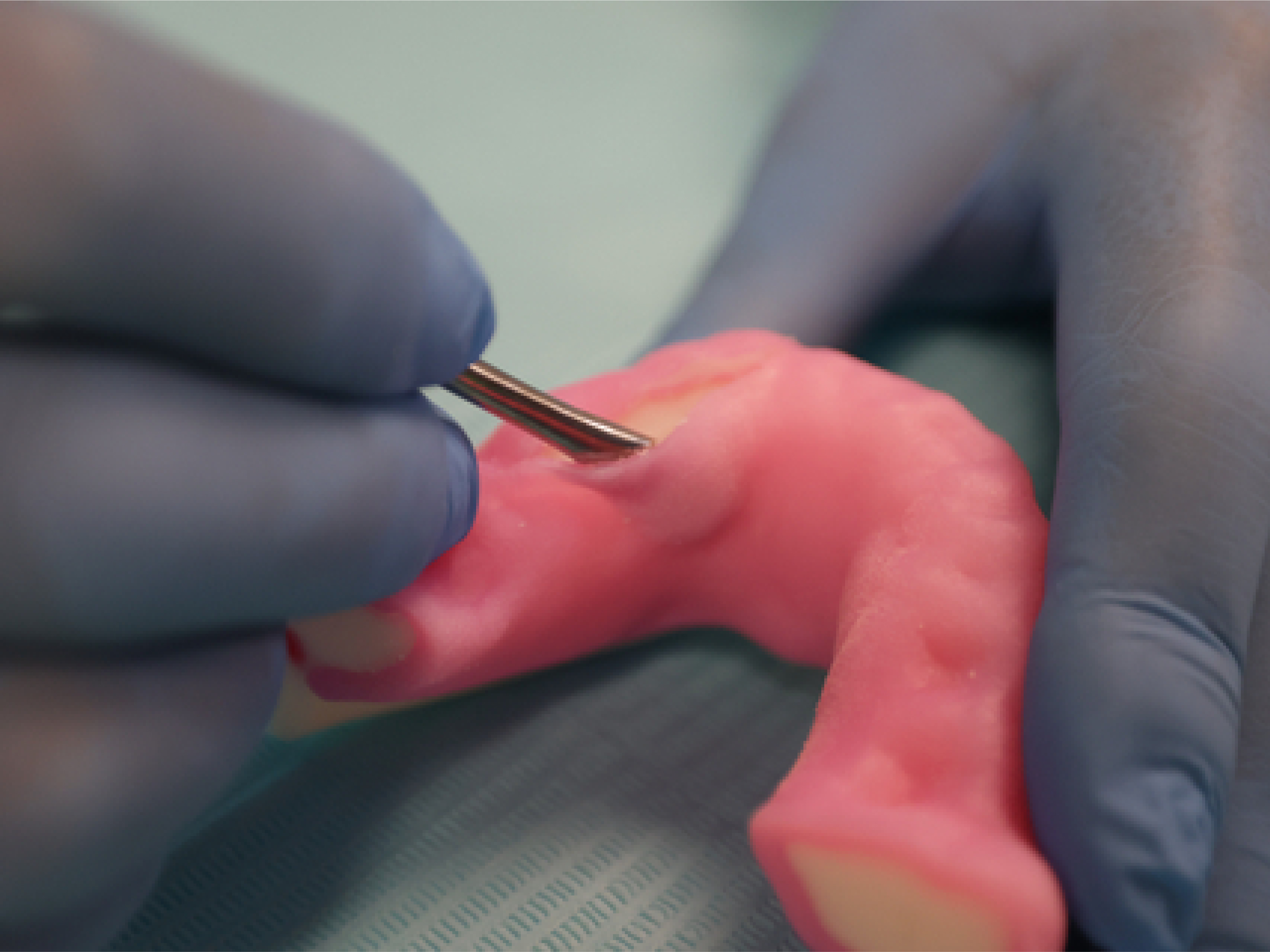
3D printing manufacturer Stratasys has recently introduced a dental anatomical model preset designed specifically for simulation-based education and clinical training.
This multi-material 3D printing solution aims to replace cadavers, animal specimens, and stone models used in traditional teaching—bypassing issues of cost, variability, and ethics all at once.
The core of the preset lies in multi-material technology. Through predefined parameters, the printer can mix multiple polymers in a single print job and control their distribution, thereby replicating the biomechanical response of bone, teeth, nerves, and soft tissue. Compared to traditional plastic models that lack detail and biological specimens with significant individual variation, these synthetic models can be manufactured at scale while maintaining consistency across batches.
The models support simulation of procedures such as drilling, cutting, suturing, and implant placement. Based on CBCT data, they can also reproduce patient-specific cases—covering complex scenarios including atrophic jaws, sinus elevation procedures, and bone grafting.
According to Stratasys' Medical VP, this solution aims to advance dental education from traditional methods toward standardized, technology-driven learning environments. Students can repeatedly practice on realistic cases before transitioning to live patient care, while device manufacturers can use anatomically accurate replicas for product validation and demonstrations.
Similar applications are expanding. Masaryk University has launched a free online 3D anatomy portal where educators can download and print bone and organ models. Stratasys' Digital Anatomy technology is also being used to print eye and eyelid models for surgical training, meticulously recreating skin, muscle, and fat layers.
Of course, limitations remain. No material can fully replicate the mechanical behavior of human tissues, high-fidelity systems remain expensive, and patient-specific models require high-quality imaging and technical expertise. But at the very least, when training can be printed on-demand without relying on specimen banks, the possibilities for educational scenarios have already expanded.