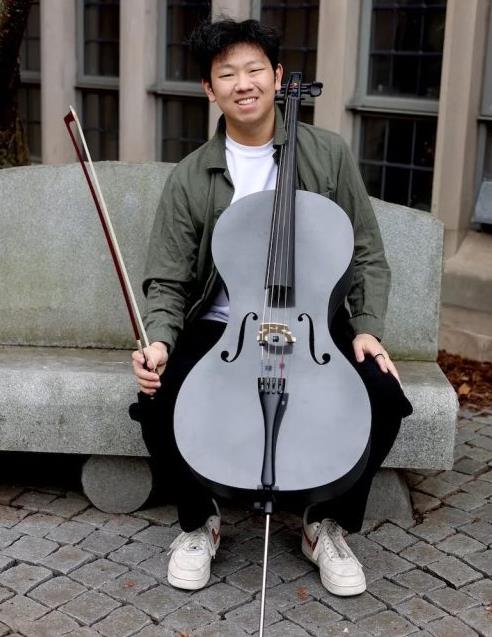
Forte3D's instrument is more affordable and durable than traditional wood cellos
With roots dating back to the 16th century, the cello is an undeniably impressive instrument, both for its size and for its resonant tones. Now, the classical cello has undergone something of a reinvention by Forte3D, a startup specializing in 3D printed instruments co-founded by lead inventor Alfred Goodrich and Yale engineering student Elijah Lee. The startup, which has leveraged advanced technologies like 3D printing and carbon-fiber-reinforced materials to create the new instrument, recently went on Shark Tank and walked away with a $250,000 investment (for 16% equity).
Goodrich and Lee were inspired to create a 3D printed cello following their own experiences with the traditional instrument, which is known to be expensive, fragile, and cumbersome to travel with. They believed they could combine 3D printing and engineering to create a version of the instrument that was more affordable and durable. Working through Forte3D, the team developed the game-changing cello that is based on a patented design and relies on cutting-edge manufacturing processes and materials.
Unlike some other projects that use 3D printing to reproduce instruments, Forte3D’s initiative has sought to redesign the cello, giving the company more control over the resulting acoustics. This redesign consists of flat front and back panels made from carbon-fiber panels, integrated with 3D printed ribs and neck. Moreover, the cello’s design can be customized in terms of shape and thickness to create unique sound profiles. Other components, like the sound post, fingerboard and bridge are traditional and thus help to preserve the cello’s unique sound.
Unlike wood, which can warp and break easily, the use of carbon-fiber and thermoplastics has resulted in a more robust instrument that can withstand changes in temperature, regular use, and the stresses of travel. The Forte3D team have also built a custom 3D printer, which can actually print a full-sized cello in a single piece.
The 3D printed cello is more than just a passion project: Goodrich and Lee see it becoming a commercially viable product that will enable more people to learn and play the cello. Renowned professionals like Yo-Yo Ma and The Piano Guys have actually reviewed Forte3D’s instruments with positive feedback. American cellist and composer Mike Block said of the instrument: “Without a doubt, think that its the greatest sounding carbon fiber cello that I’ve ever heard, that I’ve ever played.”
The positive reviews and quality of the 3D printed instrument led to a big milestone recently, when Forte3D brought the instrument onto Shark Tank in the hopes of receiving a $250,000 investment for 10% equity. Following their presentation, investor Lori Greiner gave them a deal for $250,000 for 16% equity. This funding will help the company to scale its operations and develop more 3D printed instruments. In addition to the cello, Forte3D also makes a 3D printed violin, and is developing a viola and double bass.
Long-term, the goal is to bring these more accessible instruments to schools. “A student in a rural school, a touring professional, or a budding musician anywhere in the world could hold one and feel the same richness, the same resonance, the same possibility,” Lee says. “If we can put instruments in the hands of more people, spark curiosity, and make music accessible to everyone, then we’ve really built something that can change the way the world hears music.”