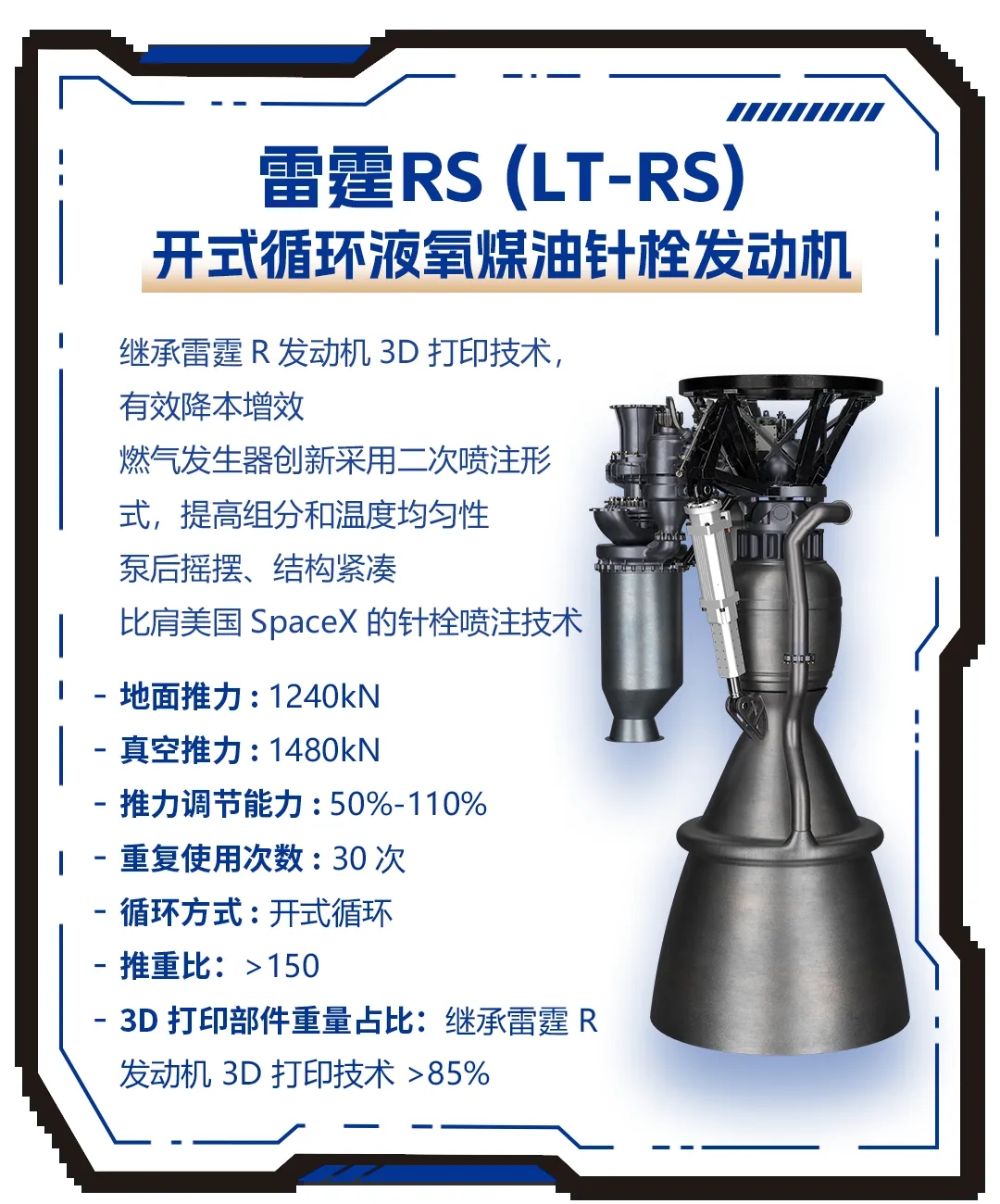
Data released by Deep Blue Aerospace shows the Thunder RS engine achieves a ground thrust of 1240 kN (130 tons), marking a breakthrough in the hundred-ton thrust class. The engine boasts a thrust-to-weight ratio greater than 150, enabling greater thrust under the same weight conditions and providing more powerful support for rocket ascent and orbital insertion. The engine's thrust can be regulated between 50% and 110%, allowing precise adjustment based on mission requirements like payload weight and orbital parameters to ensure the rocket follows the optimal trajectory into its intended orbit. During the recovery phase, this capability ensures the rocket descends at the optimal speed and angle, increasing the success rate of recovery.
Building on the manufacturing advantages of Deep Blue Aerospace's Thunder engine series, over 85% of the Thunder RS components are produced using 3D printing technology. This approach significantly reduces engine weight and enhances production efficiency while meeting high-performance demands. For instance, key parts of the engine's turbopump, including the pump casing, impeller, inducer, turbine casing, and turbine stator, are formed using 3D printing technology. The engine's oxygen main valve is a low-temperature angle poppet valve with its casing integrally formed from high-temperature alloy via 3D printing. The kerosene main valve is a normally closed straight-through poppet valve with its titanium alloy casing also integrally 3D-printed, ensuring reliability while reducing unnecessary parts and associated components.
The thrust chamber, a core component of the engine, utilizes a combined "belt-like film cooling + regenerative cooling" method. The inner wall is made of copper alloy with high aspect ratio cooling channels, offering significant advantages in cost and production cycle, while providing better resistance to the high heat flux caused by high chamber pressure.
The engine's pintle injector head employs a high-temperature alloy for the first time, using a "regenerative + self-impinging" cooling method and is manufactured via 3D printing followed by precision machining. It connects mechanically with the center column to form the liquid oxygen injection flow path. Compared to traditional copper alloys, this enhances the engine's operational stability and reliability.
The complete success of this initial test firing preliminarily verifies the coordination of the Thunder RS engine system and the functionality of its key components, laying a foundation for subsequent development work. Based on the results and experience from this test, Deep Blue Aerospace will further optimize the engine's performance, enhance its reliability and stability, and explore its performance limits under different operating conditions, steadily advancing towards the goal of efficient, safe, and reusable space launch capabilities.
Source: Deep Blue Aerospace