Home  >  News

April 15, 2026      News      9493

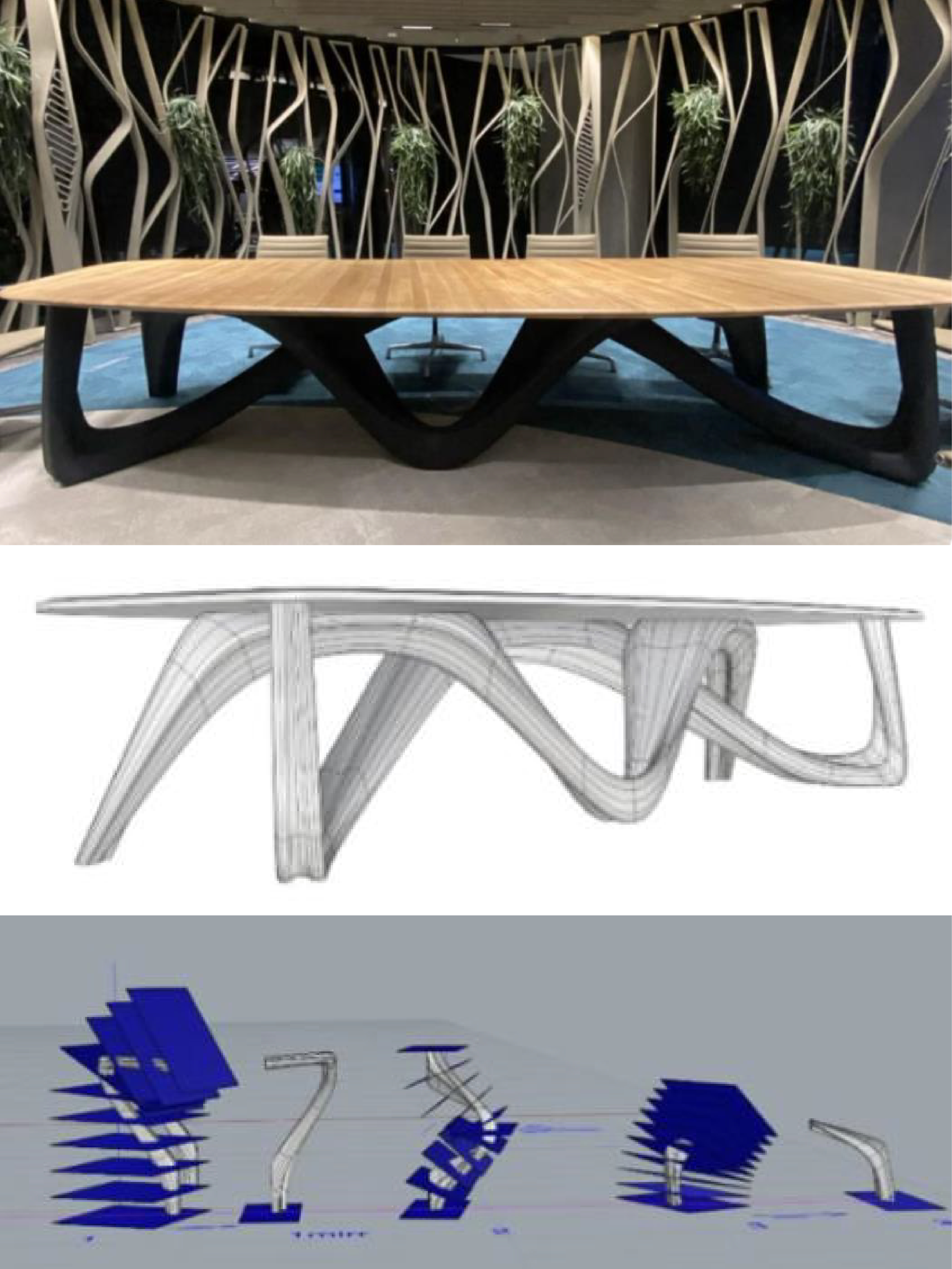
Inside a circular conference room constructed almost entirely with 3D printing, a table featuring a base produced using large-format additive manufacturing has become the centerpiece.

Freelance designer Jaroslav Baron showcased the project on LinkedIn, where its elegant organic forms sparked widespread discussion within the industry.
The table base consists of several separate components, all printed using Large Format Additive Manufacturing (LFAM) technology. In contrast to desktop-level equipment, LFAM enables the rapid production of full-scale parts that would be difficult to fabricate using traditional processes. Baron employed a non-planar printing strategy, where the print head moves at varying angles rather than strictly in horizontal layers. This approach improves structural strength and makes it possible to achieve complex geometries.
The entire design was modeled using SubD surfaces in Rhino software, resulting in fluid, root-like forms that create a striking contrast with the smooth wooden tabletop. When asked about the assembly method, Baron explained that the components are screwed into the tabletop from below and connected to each other via internal fasteners—eliminating the need for glue or welding and allowing for easy disassembly.
When questioned whether the other vertical decorative elements in the conference room were also 3D printed, he left the answer open-ended: "to be continued."
The true breakthrough of this project lies not in the technology itself, but in the scale and context of its application. A conference table must be stable, durable, and visually cohesive with its surroundings. Here, 3D printing not only meets all functional requirements but also achieves forms that would be difficult and costly to replicate with traditional woodworking or metal fabrication. In this context, it is no longer a novelty—it is simply the best tool for the job.


©2025 3dptimes.com All Rights Reserved