Home  >  News

February 14, 2026      News      7612

3D Printing Tech Discovery: TOP.E R1 Aims to Redefine the Market with AI and Five-Axis Motion

As 3D printing technology gradually moves from the industrial sector to the mass consumer market, a new printer product integrating advanced mechanical structure and artificial intelligence has recently caught the industry's attention. Chinese technology company TOP.E has announced the launch of the TOP.E R1 – a home/desktop-level AI-driven 5-axis FDM (Fused Deposition Modeling) 3D printer – and plans to officially introduce it to the market via a crowdfunding platform. This is being viewed within the industry as an innovative breakthrough in 3D printing technology.

Technical Highlights: 5-Axis Motion + AI Model Generation

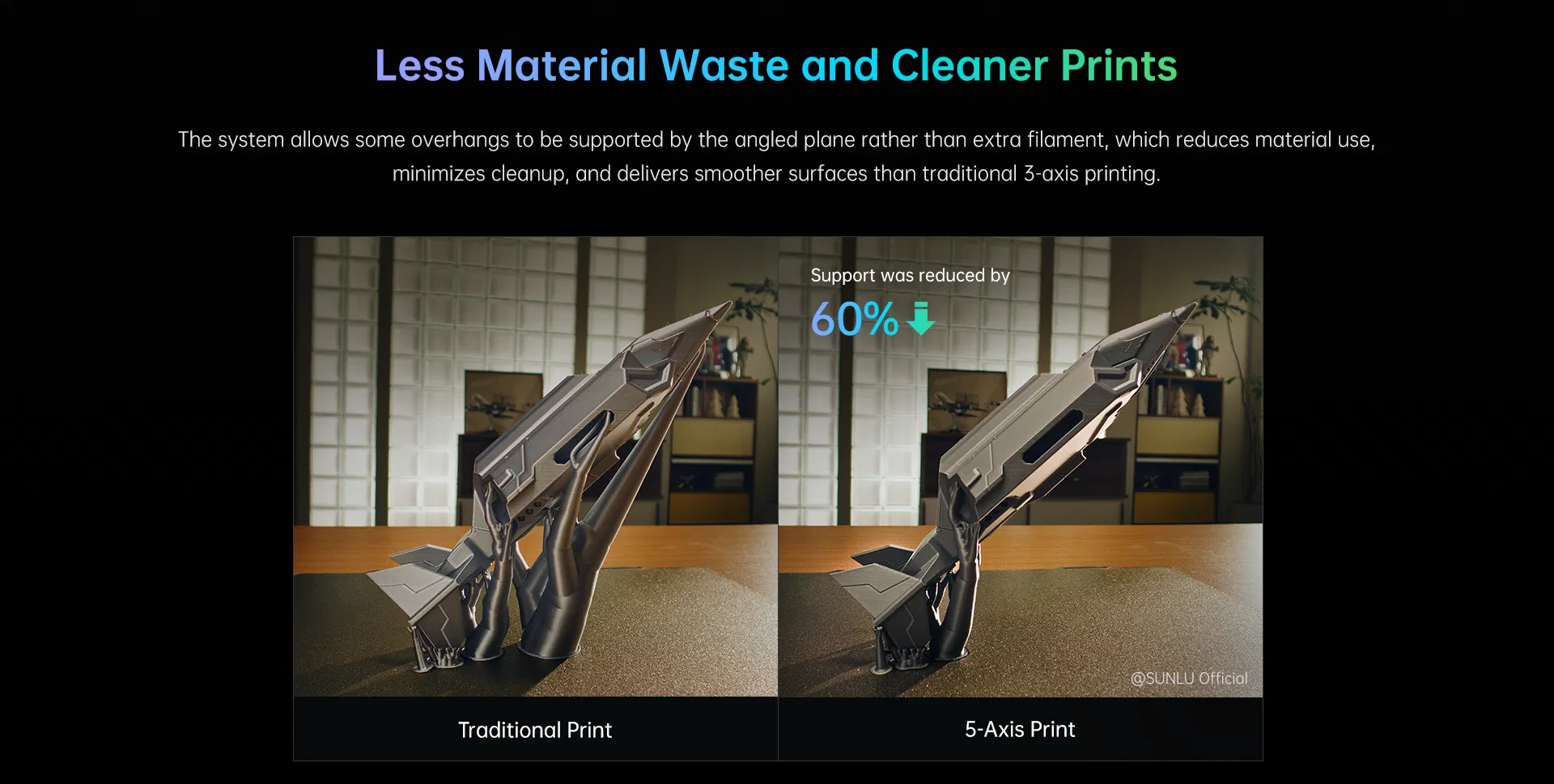
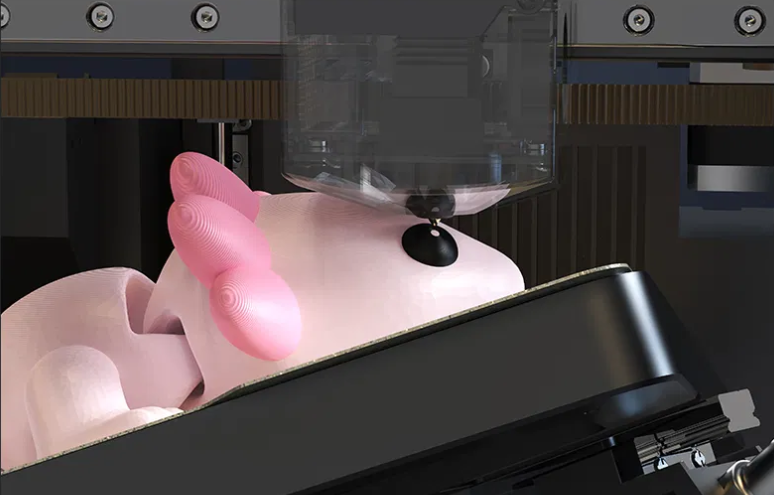
Unlike traditional three-axis 3D printing systems, the TOP.E R1 adopts a 5-axis CoreXY mechanical structure. Through its X, Y axes and three independently driven Z axes, it achieves dynamic tilting of the print bed during the printing process, allowing the build platform to tilt up to a maximum angle of approximately 30° in three directions. The core advantage of this design is its ability to significantly reduce or even eliminate the need for support structures when printing complex shapes, thereby saving material, shortening print times, and improving the final surface quality.
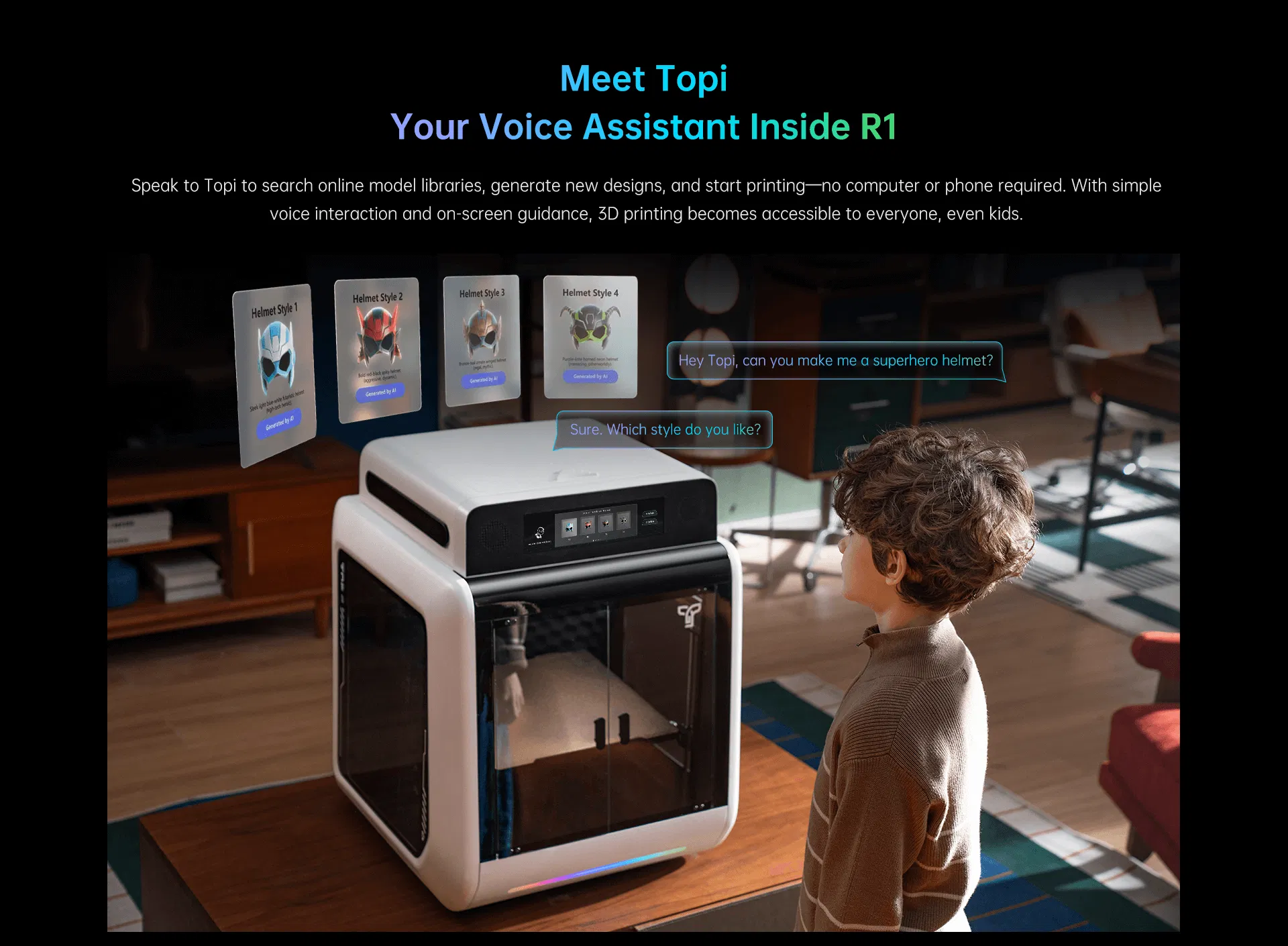
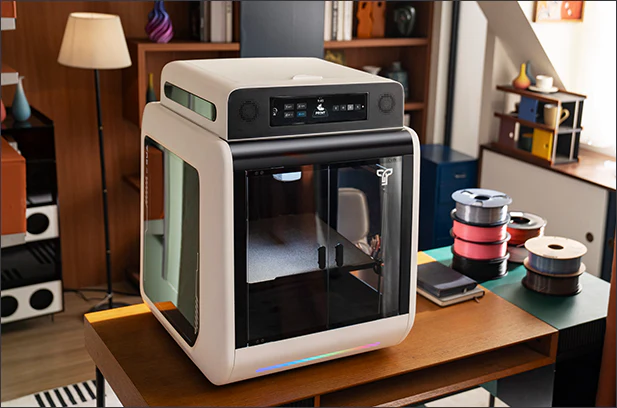
Simultaneously, the TOP.E R1 is equipped with a large touch display and an integrated AI assistant, "Topi." Thanks to integrated speech recognition and large language models, it not only supports voice control but can also generate ready-to-print 3D models directly on the device from simple text descriptions or image inputs. This "Text-to-3D" capability is seen as a key feature that significantly lowers the barrier to creative design.

Key Specifications and Features

According to the currently available technical information, the main specifications of the TOP.E R1 include:
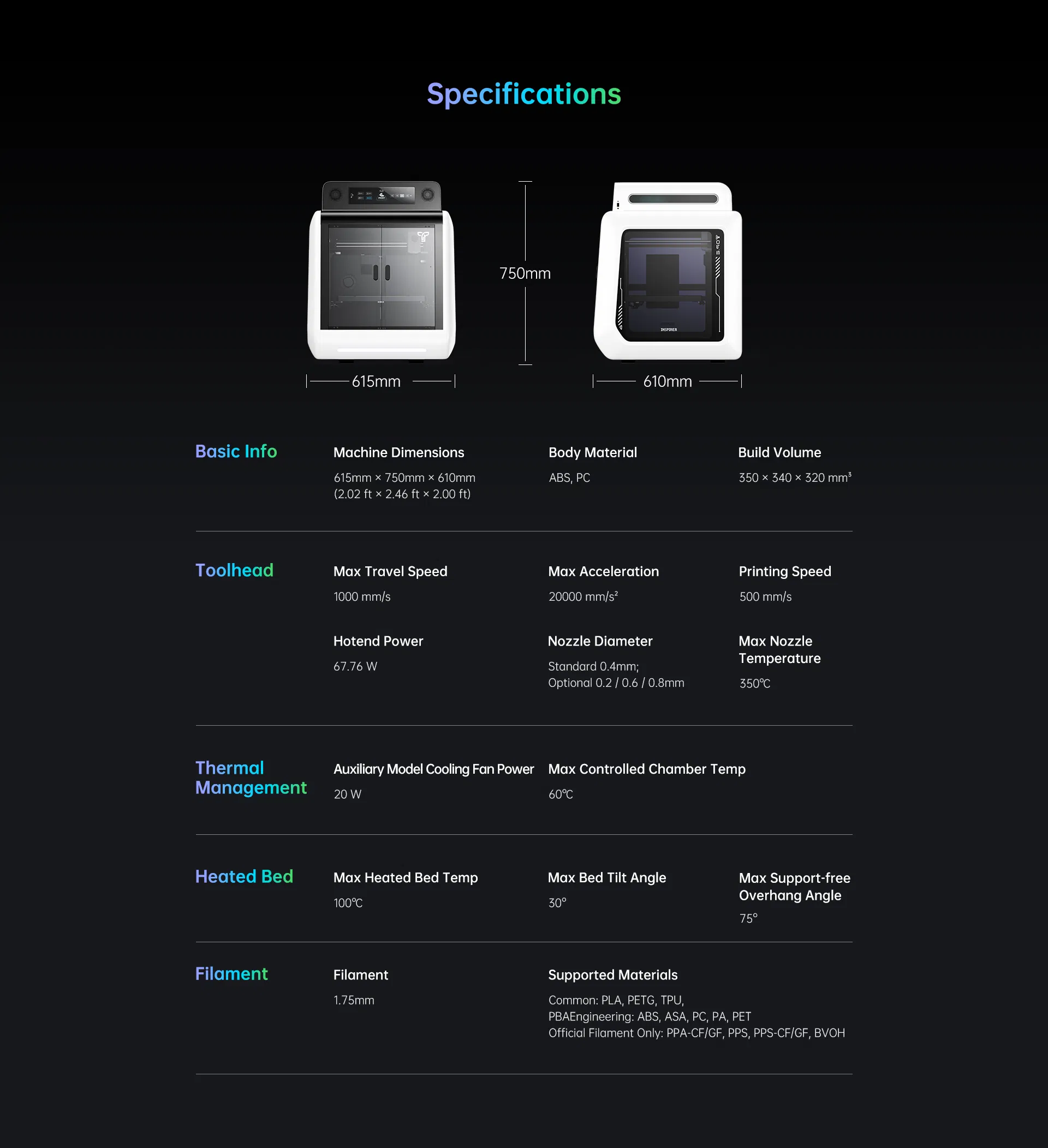
Build Volume: Approximately 350 × 340 × 320 mm, suitable for creating medium-sized physical objects.
Print Speed: Up to approximately 500 mm/s.
Heated Bed & Active Chamber: The heated bed can reach up to approximately 100°C, and the actively heated chamber can maintain around 60°C, providing a stable environment for high-precision printing.
AI Intelligence: Integrates various AI models, including Tencent HY and Tripo, for voice interaction and automatic model generation.
Display & Operation: Features an 11.4-inch touchscreen, allowing users to complete design, print preparation, and control independently on the device.
Furthermore, thanks to its 5-axis dynamic tilting and intelligent slicing strategies, it aims to achieve printing of overhangs up to 75° without requiring support structures. If this potential is validated in practical use, it could challenge the limitations of traditional layer-based printing processes.

The Broader Context Driving Rapid Growth in Consumer 3D Printing

The global 3D printing equipment market is currently experiencing a phase of rapid development. Industry data indicates a significant increase in China's 3D printing equipment production, with the consumer market growing particularly fast, fostering technological innovation and providing fertile ground for the popularization of new products.
In recent years, numerous 3D printing projects launched via crowdfunding platforms like Kickstarter and Indiegogo have not only driven the rapid evolution of equipment technology but also sparked public interest in printing tools. For example, another consumer-oriented printer employing new technology attracted tens of millions of dollars in pledges on a platform, further demonstrating the strong market demand for innovative printing products.

Challenges and Expectations

While the TOP.E R1 represents a clear breakthrough in its technological approach and conceptual features, industry observers point out that the key to truly achieving large-scale, stable application still depends on the maturity of multi-axis non-planar slicing software. The advantages of 5-axis printing can only be fully realized with efficient software support, which represents a complex and challenging part of the entire printing process.
Additionally, as a crowdfunding project, there remains some uncertainty before mass production regarding whether the product will ultimately launch as scheduled and whether its performance will match the promotional claims. Crowdfunding platforms themselves do not guarantee product delivery, so consumers should rationally assess the risks when supporting such projects.

The TOP.E R1, as a 3D printer integrating a 5-axis motion system, AI-driven design, and large-screen operation, represents an innovative direction for current consumer-grade 3D printing technology. Its potential to reduce support structures, improve printing efficiency, and lower the operational difficulty is worth watching, but its market performance and actual application effectiveness still need to be verified over time. As crowdfunding officially commences, both the industry and users will be closely watching whether this product can indeed initiate a new trend as expected.


©2025 3dptimes.com All Rights Reserved