Biohybrid method achieves 20-μm resolution, outperforming commercial nozzles with biodegradable, low-cost advantages for manufacturing and bioprinting.
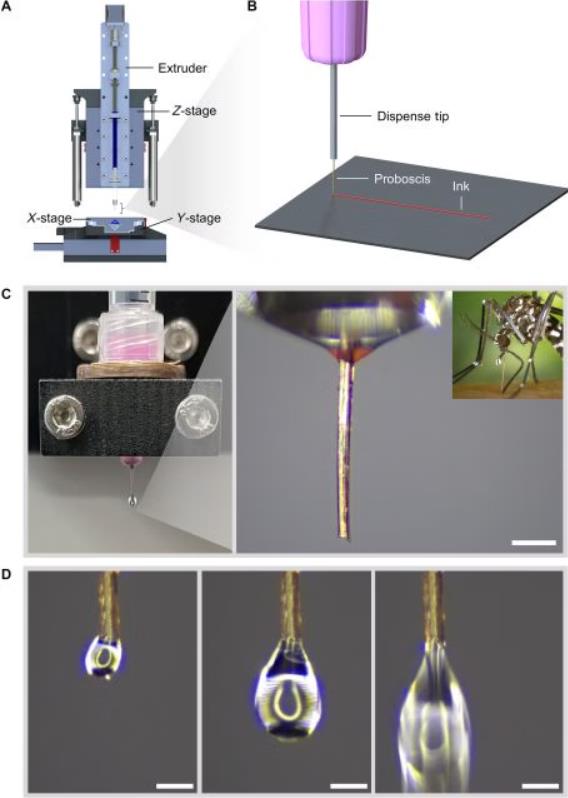
Researchers have demonstrated a 3D printing approach that repurposes the natural anatomy of mosquitoes for high-precision fabrication. The technique, termed “3D necroprinting,” uses the proboscis of female Aedes aegypti mosquitoes as a biological nozzle capable of producing structures with line widths as fine as 20 micrometers—roughly twice as precise as commercial 36-gauge metal tips.
The study, published in Science Advances on November 19, 2025, by Justin Puma, Zhen Yang, and colleagues at the University of Houston, introduces a biohybrid manufacturing method that integrates nonliving biological materials directly into engineered systems. The mosquito proboscis’s slender, straight structure and internal mechanics allow it to withstand internal pressures of up to 60 kilopascals, sufficient for continuous ink extrusion during direct ink writing 3D printing.
A biological nozzle for microscale printing
The researchers identified the mosquito proboscis as an optimal candidate for micro-scale fluid dispensing after surveying dozens of natural structures, including stingers, fangs, and plant xylem vessels. With an average inner diameter of about 20 to 25 micrometers and a stiffness of roughly 200 megapascals, the mosquito fascicle offers mechanical stability comparable to plastic while maintaining an internal geometry suited for laminar fluid flow.
Mounted onto a custom-built DIW 3D printer, the mosquito proboscis nozzle produced high-resolution prints of complex geometries, including a honeycomb lattice, a maple leaf, and a bioscaffold laden with live cancer cells and red blood cells. The printed cell structures maintained a viability rate of more than 86 percent, suggesting that the nozzle can handle biologically sensitive materials without excessive shear stress.
A low-cost alternative to synthetic tips
Conventional micro-dispense tips are typically made of metal or plastic and can cost up to $80 per unit. The biological nozzle, by contrast, can be fabricated for less than $1 using sterilized, laboratory-reared mosquito material. Researchers estimate each mosquito proboscis to cost about $0.80 to prepare, making it a cost-effective and biodegradable substitute for conventional tips.
While the biological tips are less pressure-resistant than metal or glass alternatives—rupturing at roughly 60 kilopascals compared with more than 20,000 kilopascals for borosilicate glass—they offer greater flexibility and environmental sustainability. Stored under frozen conditions, the mosquito-based nozzles remained functional for up to a year.
The team describes the work as a step toward integrating biotic materials into advanced manufacturing, where natural microstructures could replace complex, non-biodegradable components. Future studies, they note, may explore other insect-derived nozzles such as those from assassin bugs, tsetse flies, or aphids, to further expand the range of sustainable biohybrid fabrication tools.