
Home  >  Materials

November 5, 2026      Materials      3DPTimes Editors | Arkema, November 4, 2026      21      Share to X.com

Arkema’s November 4 update focuses on elastomeric resins for footwear, sporting goods and other consumer products. The announcement gives no new resin grade or launch date.

Archive photo, 2020. Designer Parfums’ F1 Fragrances Engineered Collection with DLS-printed bottle exoskeletons. Photo by Designer Parfums via PR Newswire.
How resin chemistry and lattice geometry work together

Arkema said on November 4, 2026 that its longstanding partnership with Carbon is targeting a new generation of 3D-printed consumer products, including footwear and sporting goods. Arkema contributes expertise in UV-curable specialty materials, while Carbon develops elastomeric resin formulations for its Digital Light Synthesis (DLS) process. The announcement did not name a new resin grade or set a commercial release date.

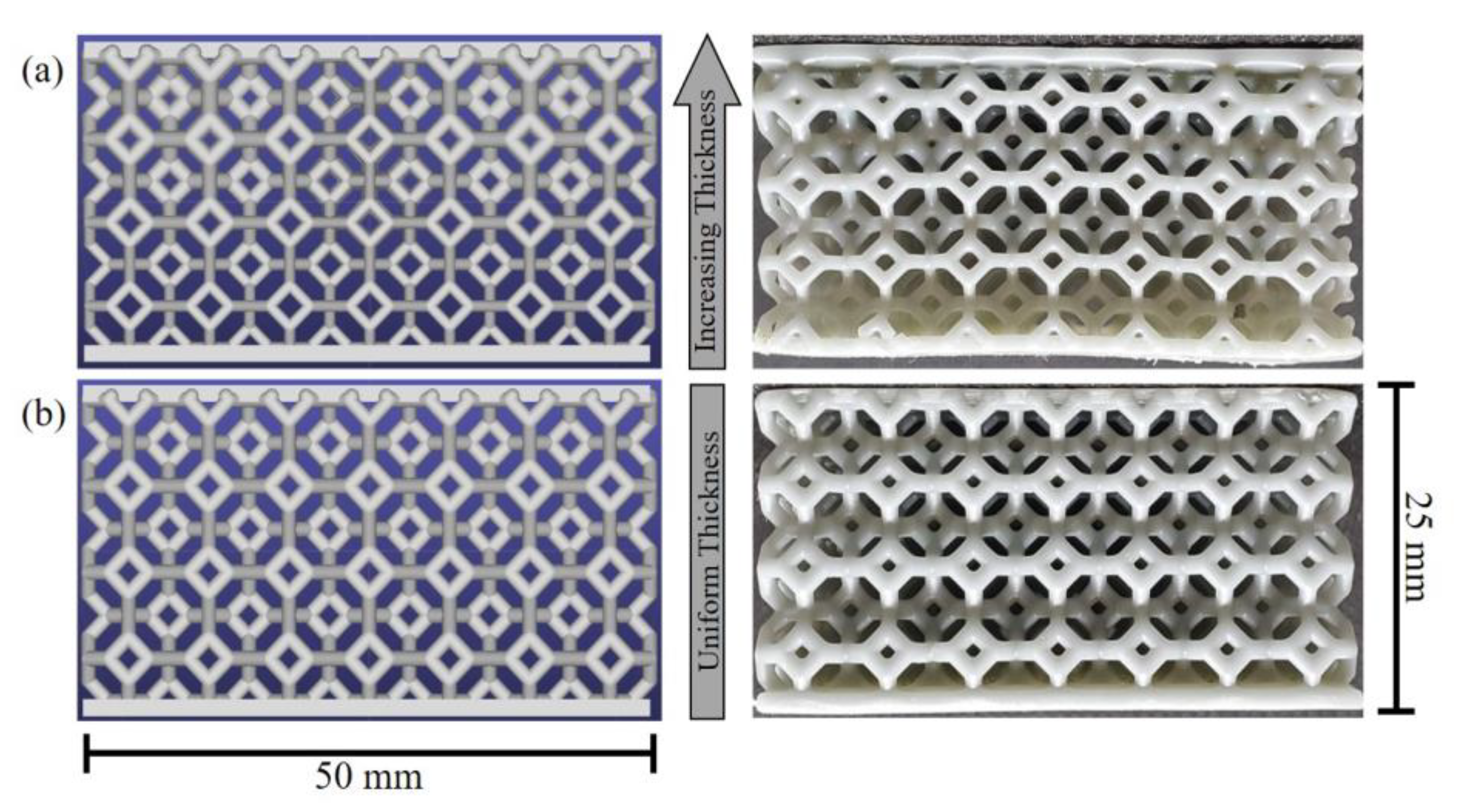
For a designer, resin chemistry and lattice geometry are separate variables. The resin determines how the printed material stretches, recovers and resists damage. The shape, size and thickness of the cells determine where the part bends and how it spreads a load. A separate 2023 study by Dwyer and colleagues illustrates that distinction by comparing graded and uniform Kelvin lattices printed in Carbon SIL30. The study predates this announcement.

Image: CAD models at left and physical SIL30 lattice specimens at right. Dwyer et al., Polymers (2023), Figure 1, reproduced unchanged under CC BY 4.0. https://doi.org/10.3390/polym15051178 | https://creativecommons.org/licenses/by/4.0/

What made-to-order footwear can tell us about scale

Vivobarefoot’s existing Tabi Gen 02 sandal shows how Carbon’s technology can fit into a made-to-order workflow. A foot scan informs the design before the sandal is printed. That workflow illustrates the move from standardized stock to individualized production. Arkema’s update does not identify the sandal’s exact resin formulation.

For a footwear or sporting-goods brand, the next milestone is evidence that those designs can be produced consistently. That means testing cushioning and rebound after repeated loading, checking dimensional variation across builds, and counting the labor and yield losses in washing, curing and inspection. Those measurements would show whether a formulation and lattice can hold their performance and cost targets in production.

Cover photo: The 2020 F1 Fragrances Engineered Collection used DLS to print resin exoskeletons around the bottles. Archive photo by Designer Parfums via PR Newswire.

Sources
Arkema partnership update, November 4, 2026
https://www.arkema.com/global/en/media/newslist/news/global/products/2026/20261104-carbon-partnership-to-advance-new-generation-3D-product/
Vivobarefoot’s VivoBiome product page
https://vivobiome.vivobarefoot.com/
3DPTimes’ earlier Tabi Gen 02 coverage
https://3dptimes.com/article/yU14yjCy4mr1VW8x
Designer Parfums release, 2020
https://www.prnewswire.com/news-releases/designer-parfums-and-f1-launch-the-official-f1-fragrances-engineered-collection-301172601.html


©2026 3dptimes.com All Rights Reserved